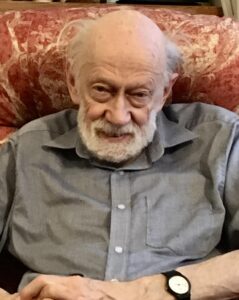
Dr Geoffrey Butcher, 29th September 1940 – 15th June 2026
Eulogy, 17 July 2026
Eulogy, 17 July 2026
Read by Michael Butcher, co-written with Helen Rawlins
We gather today to remember and give thanks for the life of Dr Geoffrey Butcher: husband, father, grandfather, great-grandfather, scientist, author, teacher and friend to so, so many. He was a man of faith, great humour and deep humility. And above all, Geoff, who to his family was Daddy, Dad, and then eventually Papa, lived a selfless life in the service of others, especially the millions of children threatened by the scourge of malaria.
He was born at the beginning of the Blitz of London during the Second World War, into a modest working-class family. His father worked long hours in the dairy trade as a bookkeeper. His mother was a cook below stairs, working for the landed gentry. Both parents knew service, hard work, duty and sacrifice – qualities which my Dad inherited.
In fact, an abiding memory his grandchildren have of him was that he thought the best thing to be was to “be useful”. In his later years, one of the reasons that frustrated him most about having Parkinson’s disease was the constraints it put on his failing body.
As an only child, my Dad was shy, thin, anxious and often alone, the last picked for sports and games, and the one who did not always fit in. But at the age of ten, he acquired a microscope for ten shillings from a shop in Coalville in Leicestershire, where his relatives lived. Through this, he found his calling, looking at life through a magnifying lens – which even at age 80+ he still delighted in – much to the amusement of his carers, who he still, even as a frail old man, tried to teach something of the scientific world.
While other boys found confidence on the sports field, my Dad found wonder in worms, insects, slides and specimens. His bemused and puzzled mother said his increasing number of scientific books gathered too much dust, but that microscope opened the door to his life’s work. And he looked closely at everything for the rest of his life.
At Emanuel Grammar School in South London, he found himself in a middle-class world that did not always know what to do with a working-class boy from West London. One schoolmaster called him a “feeble cabbage” because he refused to join the army cadet force.
Many people would have buried that insult, but my Dad later reclaimed it for the title of his autobiography. That was totally him. He was always able to see the absurdity of those who might belittle him, and able to turn that condescension into a joke he would laugh at, and often tell.
This is illustrated by the story he loved to tell about a hospital consultant who was insisting that I, as a baby, needed more tests. Eager to take his wife and clearly healthy baby home, Dad thought this all a bit excessive, and — under pressure to hurriedly think up an excuse to get out of these tests — he blurted out the immortal phrase: “But I only have a little car!”
He loved to tell this self-depricating story, with Sue always eager to join in, and her often crying with laughter long before he’d reached the punchline. It was no wonder he was a fan of English comedic songs and the great duo Flanders and Swan, who you will be hearing at the end of the service.
At Emanuel he won a State Scholarship, and then went to King’s College London, studying zoology and the biological sciences. After university, and a teaching course in Bristol, he saw an opening for a biology teacher in Nigeria.
Those two years changed the direction of his life. In Nigeria, he saw the importance of malaria, one of humanity’s oldest enemies, not as an abstract disease in a textbook, but as an urgent threat to millions of people, especially children. His experience there convinced him that this was work worth doing.
Back in London, he saw an advert for role as a malaria researcher. From that began a long and diverse career, first at Guy’s Hospital London, then the London School of Hygiene and Tropical Medicine, Porton Down on Salisbury Plain, Newcastle Medical School in Australia, the Australian National University in Canberra, and finally at Imperial College London.
Moving entire countries and several cities in the early 1980s was something few men would have done. But he did it because he passionately believed in what he was doing, and in doing so he enriched the life of his family, opening us to new experiences.
He published more than a hundred scientific papers. He applied for grant after grant after grant, never falling back on a tenured position. He helped make the first ever live film of malaria parasites invading red blood cells and being inhibited by an antibody.
And there was one moment that deserves to be remembered. At a World Health Organisation meeting in the early 1970s, when malaria research risked taking a narrow and, in his view, mistaken direction, Geoff spoke up. He was the youngest and least experienced person in the room. He had no title to hide behind, no great institutional power. But he said what he believed was true: that science must not be constrained by bureaucracy; that promising alternatives should not be shut down too early.
And years later, the vaccine work being trialled today follows lines of research that my Dad had defended when it mattered. He was never publicly recognised for that contribution in the way he might, or should have been. But to live long enough to see malaria vaccine trials in Africa was, for him, a greater reward than any public accolade.
However, I would like to acknowledge the praises that have flooded in from many of his former scientific colleagues since his passing, including by his former colleague and life-long friend, Laurie Bannister, who is here today.
But my Dad’s life was never only the laboratory. It was Sue. His autobiographical memoir is dedicated simply: “For Sue, who taught me the meaning of love.” Sue, from South Africa, was the great love of his life, and with whom he also shared a love and fascination of Africa. Together they raised a family, sadly losing two further children at birth. But together they went on to provide a foster home for 17 children.
They made homes across continents, and built a life marked by patience, kindness, laughter, endurance – and the odd argument! He dearly loved me and my sister, Helen. He loved his grandchildren, Christopher, Theo, Charlie and James, and his great-grandchildren Ray and the newest arrival, Bobby. And they loved him back.
My Dad is remembered with great affection by his grandchildren. For instance, by my son Christopher who, as a toddler, very seriously asked him not to jump on the sofas!
By Theo who loved being taken by my Dad to look at the frogs in his garden pond. By Charlie, who fondly recalls trips to the science museum after my Dad had checked on his mosquitos at Imperial. And by Helen’s son James, who he taught to ride his bike as a toddler in the Isle of wight.
Similarly, my sister Helen and I remember him as kind, thoughtful father as we were growing up, always there to suggest something to do when we shouted “I’m bored” – mostly suggesting something to do in the garden like tree rubbings, or reading a book, or playing with a train set.
And we all remember the cries of “Geoff!” coming from our mum whenever she needed to rouse him from whatever book he had disappeared into. He was practical, making a dolls house and mini-dresser for Helen, and tirelessly working with me on my model airplanes.
He was steady, watchful and present. The kind of love he exhibited was not so much sentimental as practical. It was the kind that fixed things, carried things, explained things, and showed up when it counted. This was evident in the countless times one of us moved house or needed help with something that involved drilling a hole or nailing something with a hammer.
My Dad saw no contradiction between science and Christianity. For him, the two belonged together. Science asked how the world worked. But faith asked what it all meant and why we were set on this earth.
He cared about his local community, organising street parties, bringing people together to share food and conversation and joining the community choir. He liked to bring people in, possibly because as a youngster and only child he had often felt alone.
Sue supported him in all of these ventures and nurtured this outgoing side of him that was absent as a child. They cherished one another, and were living examples of how to not take the other for granted, to support and to love each-other no matter what.
So today we mourn him. But we also give thanks. Thanks for the shy boy with the microscope. Thanks for the man who stood up at the scientific conference when it counted. Thanks for the researcher who’s tireless work served children he would never meet.
Thanks for the husband who loved Sue. Thanks for the man who loved his family. Thanks for the always faithful servant of God, who still kept asking questions to the end. May he rest in God’s house.
And I am sure that he will be delighted on tending his new heavenly garden, which as we all know, must have a winding path leading to the shed at the back, with two flower beds on either side, just as he always planned his own, with beds of wild flowers either side. And perhaps a chicken hutch. And maybe a nearby allotment.
There he can once again dig, plant, tend, observe, and rejoice in the living world he spent his life observing and trying to improve.
We commend our father, grandfather, great-grandfather, Geoffrey to God: not as a feeble cabbage, but as giant Oak tree. A true scientist, a faithful Christian, and a dearly loved man.
May he now rest in peace.
We love you Papa.